KPop Demon Hunters: Tigers, Magpies and Black Hats Explained
Derpy’s comic face recalls Korean folk painting. Sussie the magpie and the Saja Boys’ black hats add references to good-news symbolism and stories about afterlife messengers. If the soundtrack brought you to KPop Demon Hunters, these details offer an easy next step into Korean culture.
Here is how to recognize those references, using two real museum objects you can compare with the film’s designs. The guide avoids ending spoilers.
| Film detail | Korean connection | What to notice |
|---|---|---|
| Derpy’s comic appearance | The playful tiger in minhwa, Korean folk painting | An imposing animal can also look wonderfully awkward. |
| A tiger and magpie together | A familiar pairing in folk art | The bird belongs to the cultural reference, too. |
| The Saja Boys’ black hats | Gat hats and jeoseung saja, afterlife messengers | Look at the crown and broad brim. |
Why does Derpy look so funny?
Netflix’s official character guide connects Derpy to babo horangi (바보호랑이), the “foolish tiger” found in Korean minhwa (민화). That gives his clumsy charm an artistic reference: a tiger can be fearsome in outline and comical in expression.
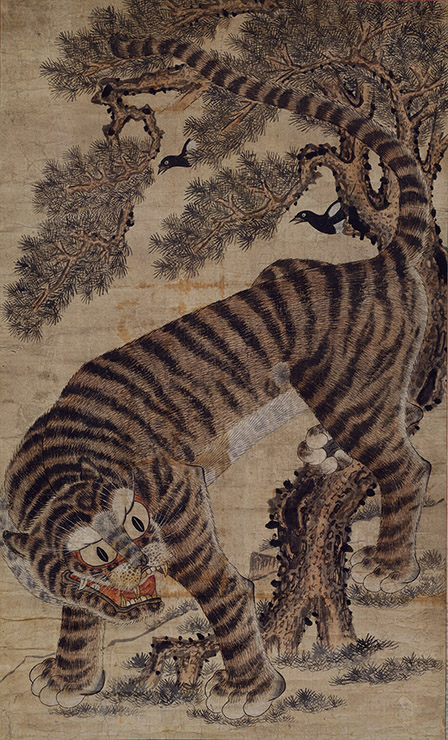
Look closely at the painting above. The tiger has a powerful striped body, but its large eyes and exposed teeth give its face a surprisingly animated quality. Two small magpies perch above it in the pine tree. The difference in scale makes the scene lively: the tiger dominates the picture, yet the birds are easy to spot.
The National Museum of Korea dates this work to the Joseon period. It is a historical example of the tiger-and-magpie pairing, rather than a reproduction of Derpy and Sussie. Looking between the painting and the characters lets you see how animation can transform an older visual idea.
What does the magpie mean?
In the Korea Tourism Organization’s cultural guide, magpies are associated with luck and welcome news. That helps explain why a tiger’s bird companion deserves attention alongside the tiger itself.
On your next look at a tiger painting, check the branches as well as the animal. Recognizing the pairing is a useful first step; you can then read the museum’s explanation of that particular work. A familiar motif leaves room for different expressions, compositions and interpretations.
Why do the Saja Boys wear black hats?
Their look draws on the jeoseung saja (저승사자). The Korea Tourism Organization explains this figure as a messenger who guides souls into the afterlife, often pictured in black robes and a wide-brimmed gat (갓). “Grim reaper” is a common English shorthand, but “afterlife messenger” makes the role clearer.
Jeoseung means “afterlife” and saja means “messenger.” That also gives the Saja Boys’ name a cultural connection you can recognize.

A gat also exists as a real historical hat. The Met’s nineteenth-century example above is made from horsehair and cow tail hair. Its tall crown, broad brim and hanging ties make the silhouette easy to recognize. The museum identifies it as a man’s hat; the connection to an afterlife messenger comes from the film’s wider costume reference.
This is a useful way to approach the movie’s cultural details: identify the real object first, then consider how the character’s setting changes its meaning. A hat in a museum and a hat on a supernatural pop star invite different readings.
A small detail worth watching again
On your next watch, look at the tiger’s expression, the bird beside it and the outline of the hats. Recognizing those details gives the film another layer, and a starting point for exploring Korean art and clothing.
Explore more Korean culture
For the clothing vocabulary behind other historical looks, try our guide to hanbok parts and styles. To start reading the Korean words used here, follow our first Hangul reading guide.
Cultural references and image permissions checked on October 8, 2026.


Comments
Post a Comment